
The Quiet Power of Financial Habits
3 small money decisions I make every day that shape my life

We started this year by focusing on habits, because habits are where change becomes real. We began with physical energy, moved into planning your day then growth and learning, and today we turn to financial habits.
Do you own a business?
Most people would say no. But the truth is, you do. You run one every single day. It’s called your personal finances.
You can hire help around the edges. An advisor can manage investments. An accountant can handle taxes. But ownership can’t be outsourced. No one else decides what you spend, what you save, or what you put off until later.
That responsibility sits with you.
And just like any real business, performance only improves in two ways: you increase revenue, or you control expenses.
On the personal side, revenue grows in two main ways. You earn more through your work, or you build investment income and let money work for you. We’ll spend more time on both of those in future posts.
But the quieter lever, expenses, is where habits do most of the heavy lifting.
Spending isn’t shaped by big, dramatic decisions. It’s shaped by small, repeated ones. Your current financial reality isn’t random. It’s the lagging result of the habits you’ve practiced for years, often without noticing. That’s why we started this year talking about habits.
Habits are where change becomes real. Over time, habits turn into practices. And practices become a way of life. That’s especially true with money. One of the most practical ways to improve your life is simple: have more money available to you. Not because money is the goal, but because money is fuel.
When used intentionally, money buys time. It reduces stress. It creates options. It allows you to invest more deeply in your health, your relationships, and the experiences that matter most to you.
When money is ignored or mismanaged, it has the opposite effect. It narrows choices. It adds friction to everyday decisions. It turns small inconveniences into major stressors. For many people, financial stress becomes the background noise of life. Always there. Always humming.
That’s why financial habits matter far more than most people realize.
Why outsourcing your money isn’t enough
I hear this often from successful people: “I don’t really deal with my money. I outsource that to professionals.” Usually, they mean they have a financial advisor managing their investments. That can be helpful. But it misses a deeper truth.
Money, like health, is the result of thousands of daily decisions.
You wouldn’t say, “I’ll eat whatever I want, never exercise, ignore sleep, and once a year I’ll see a doctor and let them fix everything.” That’s not how the body works.
Money works the same way. A financial planner can help you invest what you’ve already saved. They can’t undo years of unconscious spending, reactive decisions, or habits that quietly drain your financial energy every single day.
Financial wealth isn’t built in a meeting once a year. It’s built in ordinary moments. The small choices you repeat. The habits you barely notice.
Here are three of mine.
1. I pay attention to small spending decisions.
Not obsessively. Not emotionally. Just honestly.
This habit didn’t start for me as an adult. It was trained early.
In the 1980s, nobody carried a phone that had a calculator in their pocket. And department stores loved complicated clearance signs. Fifty percent off, plus an additional forty percent off clearance prices. It looked like ninety percent off, but it wasn’t. It was seventy.
My mom knew that. And she made sure I did, too.
When we shopped, she turned me into her human calculator at a young age. She’d hold up a thirty-dollar shirt and ask what it cost after the discounts. Half of thirty was fifteen. Forty percent off that was six. Nine dollars total.
What stuck wasn’t just the math. It was the mindset.
Why pay full price for something you didn’t need right now, when patience could save you seventy percent a few months later? Why confuse marketing with value?
That awareness stayed with me. Not because I’m unusually disciplined, but because once you learn to notice, you can’t unsee it.
That same habit shows up today in smaller, more ordinary places. The classic example is the daily coffee.
A $7 drink doesn’t ruin anyone’s financial life. And if that coffee brings you real joy, connection, or a moment of calm you genuinely value, keep it. This isn’t about shame or deprivation.
But if it’s just a habit, something you buy without thinking, it’s worth pausing.
That same seven dollars invested daily over thirty years, assuming a ten percent annual return (approximate return of the S&P 500 over the last 30 years), turns into roughly $420,000. Not because seven dollars is magical, but because compounding is.
The point isn’t “don’t buy coffee.” The point is awareness.
The same thing happens at the grocery store. Buying the same items every week without noticing price changes. Ignoring sales on things you buy all the time. Paying six dollars for something that regularly costs four when patience would have done the work for you.
Those dollars don’t disappear in one dramatic mistake. They leak out through hundreds, sometimes thousands, of unexamined decisions over time. And when small savings are intentionally redirected toward investing instead of quietly absorbed into lifestyle creep, they become meaningful.
Raindrops make oceans. Money habits work the same way.
2. I don’t carry consumer debt.
This one is simple, but it isn’t easy.
And if you’re carrying some right now, that doesn’t mean you’ve failed. It just means you’re human, living in a system designed to make spending easy and consequences invisible.
What I learned early is that debt doesn’t just cost money. It costs options.
Credit card debt, in particular, is one of the most reliable wealth destroyers in modern life. Banks love it because it earns them twenty percent or more annually. Compounded over time, that math is brutal for the person on the other side of the equation.
The average American carries more than $6,000 in credit card debt. That number isn’t a moral judgment. It’s a reminder of how quietly this habit forms.
What helped me wasn’t fear. It was reframing. I stopped thinking of credit cards as borrowed money and started treating them as a tool. I put almost everything on a card, not to spend more, but to create clarity. One clean record. One place to see patterns. Points or cash back as a bonus. But the balance gets paid in full. Every month.
I’ve seen what happens when expenses slowly rise to meet income. Debt for consumption steals future freedom. Debt for investment, used intentionally, can build it. That distinction matters.
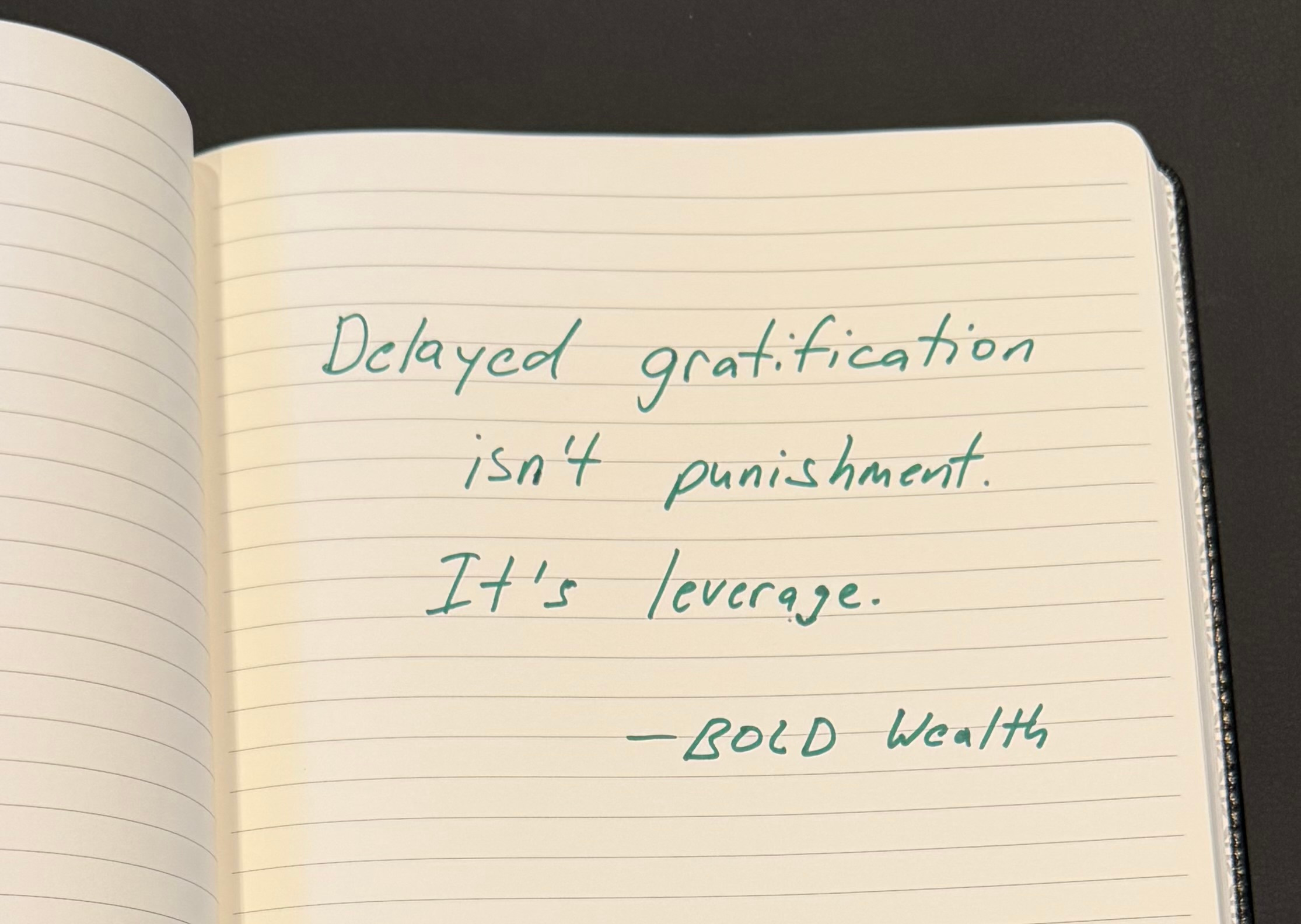
Delaying gratification isn’t punishment. It’s leverage.
When expenses don’t automatically grow with income, margin appears. And margin is where saving and investing become possible. It’s where stress begins to lift. It’s where confidence starts to build.
And that margin leads directly to the next habit, because once you stop financing the present with the future, you finally create space to build something lasting.
3. I save and invest first, then spend what’s left.
This habit shapes everything else.
Most people do it backward. They spend first, then hope there’s something left to save. There usually isn’t. Not because they’re careless, but because spending expands to fill whatever is available. I flipped that order early.
Saving and investing became a non-negotiable bill I pay to my future self. Money gets set aside first. What remains is what I’m free to spend, enjoy, and live on without guilt.
This didn’t start when I had excess income. It started when I didn’t. And like any habit practiced early, it stuck. Saving creates stability. It removes background stress and gives you breathing room. Investing creates momentum. It turns patience into progress and time into an ally.
This doesn’t need to be complicated. A simple, low-cost index fund and consistent contributions go a long way. Complexity doesn’t build wealth. Consistency does.
Markets will rise and fall. That’s normal. What matters is staying invested through the uncomfortable seasons. Investing can be volatile in the short term but powerful over time. The people who build wealth aren’t the ones who time the market perfectly. They’re the ones who keep showing up, especially when others panic.
This habit works because it removes decision fatigue. You don’t debate whether to save. You’ve already decided. And once that decision is automated, everything else gets easier.
The best investment is still you
There’s another layer to all of this that matters just as much. The best investment you’ll ever make isn’t a stock, a fund, or a deal. It’s you.
Your health. Your energy. Your ability to think clearly. Your judgment under pressure. Your capacity to learn, adapt, and make good decisions over time. Those assets compound just like money does, and in many cases, even faster.
I didn’t plan on needing money to care for my dad as his health declined. But when that season came, financial stability gave me the ability to help without hesitation. That experience made something very clear.
You can major in helping others. You can pour yourself into meaningful work. But we should all minor in money. Because money touches everything, especially in the moments that matter most.
When your financial habits improve, stress decreases. When stress decreases, energy improves. When energy improves, presence follows. And when presence increases, relationships, health, and fulfillment tend to follow right behind.
Money doesn’t create a meaningful life. But it removes many of the barriers that get in the way of living one. That’s why these habits matter.
The real shift
Financial habits aren’t restrictive. They’re freeing. They reduce anxiety instead of adding to it. They replace uncertainty with clarity. They give you control over your time and energy instead of letting money quietly control both.
This isn’t about perfection or obsessing over every dollar. It’s about direction. About deciding, intentionally, where your money goes instead of wondering where it went.
Small decisions, made daily and with awareness, compound into something powerful. A life that feels steadier. Lighter. More aligned with what you actually value.
That’s what financial habits are really for. Not to make you rich on paper. But to help you build a life that feels rich while you’re living it.
💡 Your Turn + Start Bold
Pick one financial habit to focus on this week:
Track one category of spending for the next month.
Pay off, or pay down, one lingering debt balance.
Automate one savings or investment contribution.
Just one. If you’re willing, leave a comment and share which one you’re choosing. Naming it makes it real, and momentum grows faster when we move together.
Momentum doesn’t come from doing everything. It comes from doing something consistently. Small decisions, repeated consistently, compound.
New to BOLD Wealth?
Here’s a simple Blueprint to BOLD Wealth that explains the philosophy, the core frameworks, and how money fits into a life that actually feels rich.
A Favor - will you consider clicking the 💚 on this post?
Clicking the little heart icon at the bottom or leaving a comment helps these posts to reach more people. Thank you so much in advance!
As always, you have me thinking. Really love this advice. Especially, "Delaying gratification isn’t punishment. It’s leverage." Yes!
I sure hope young people are paying attention to your advice. It's spot on for all of us.