
Habits, Part 2: Planning Your Day
If you don’t decide how your day starts, someone else will.

I broke my own rule.
It was barely 6:00 a.m. I was half awake, standing in the kitchen with my phone in my hand. I told myself I was just checking one thing. Just a quick glance before the day really started.
One email.
The subject line made my stomach drop. A subcontractor had missed a deadline. The client was upset. Messages were already stacking up, each one more urgent than the last, all asking the same question. What are we doing about this?
That single email hijacked my day before it ever began.
Instead of easing into the morning, my body tightened. My mind jumped straight into problem-solving mode. Who dropped the ball? What needs to happen next? How do we fix this? None of it could be solved at six in the morning, but my nervous system didn’t know that.
By the time I reached the office, I was already behind. Not on tasks, but on intention. The morning I had planned was gone, replaced by a reactive blur of calls, emails, and emotional labor.
Sometime around lunchtime, after a full morning of putting out fires, I realized what had really happened.
I hadn’t lost my morning to that email. I had given it away. If you don’t plan your day, someone else will.

Why Planning Your Day Matters
Mike Tyson once said, “Everybody has a plan until they get punched in the mouth.”
Most days, life throws punches early and often. Emails. Texts. Slack messages. Requests that feel urgent simply because they arrive loudly. None of them are inherently bad. But taken together, they can quietly take control of your day.
Without a plan, your energy gets spent wherever the pressure is highest. You move from one reaction to the next, mistaking activity for progress.
In Part 1 of this habits series, we talked about energy. Because without energy, nothing else works. When you’re tired, distracted, or depleted, even the best intentions fall apart.
But energy alone isn’t enough. You also need direction.
Planning your day is how you decide where that energy goes before the noise starts. It’s not about controlling every minute or creating the perfect schedule. It’s about clarity. About deciding what actually matters and giving yourself a real chance to act on it.
Designing the Day Before It Designs You
Over the years, I’ve built daily routines that help me stay grounded and focused. They’ve evolved as my life has changed, but the principle underneath them hasn’t.
I design my day before the world gets a vote.
That doesn’t mean nothing ever goes wrong. It means I start from a place of intention rather than reaction.
Here’s what a typical weekday looks like for me.
I set my alarm for 5:20 a.m. Not to be productive, but to protect quiet. Most mornings, I wake up before it goes off, a small sign that my body has had the rest it needs.
I spend about ten minutes meditating. Nothing complicated. Just enough time to clear my head and slow my breathing before the inputs begin.
Then I take a moment for gratitude, review my goals, and choose my Big 3. The three things that must get done that day, no matter what. Not a long list. Just the priorities that truly move things forward.
Around 6:00, I head to the gym for my group fitness class. Movement first thing sets the tone for the rest of the day. It sharpens my focus and stabilizes my mood in a way nothing else does.
After that, it’s a protein shake and a shower. I always finish with sixty seconds of cold water. Not as a toughness test, but as a reset that fires up my energy for the day ahead.
Then I head to the office.
And here’s the part that matters most: I still haven’t checked email.
Guarding the Morning
I refuse to give away my mornings to other people’s problems.
Mornings are when my energy is highest. When my thinking is clearest. When I’m most capable of doing meaningful work instead of busy work.
Emails, texts, and messages all feel urgent in the moment. Most of them are not. But once you open the door, it’s hard to close it again. One bad message can shift your mindset for hours.
That’s why I don’t check email until I’m fully in the right headspace. I want to decide how my day begins, not let an inbox decide for me.
When I do open email, I block two focused hours for it. Calls, responses, decisions. I clear the decks and move on.
Guarding your mornings isn’t about avoiding responsibility. It’s about sequencing. Handle what matters most while your energy is strongest. Then deal with the rest.
Your mornings set the emotional tone for your entire day. Protect them accordingly.
Time-Blocking What Matters
From about 10:00 a.m. to 3:00 p.m., my calendar is open for meetings. That’s when other people get access to me.
But my mornings belong to my priorities.
That’s when I work on the Big 3. The few things that actually move my life and work forward, not just keep me busy.
Here’s why that matters.
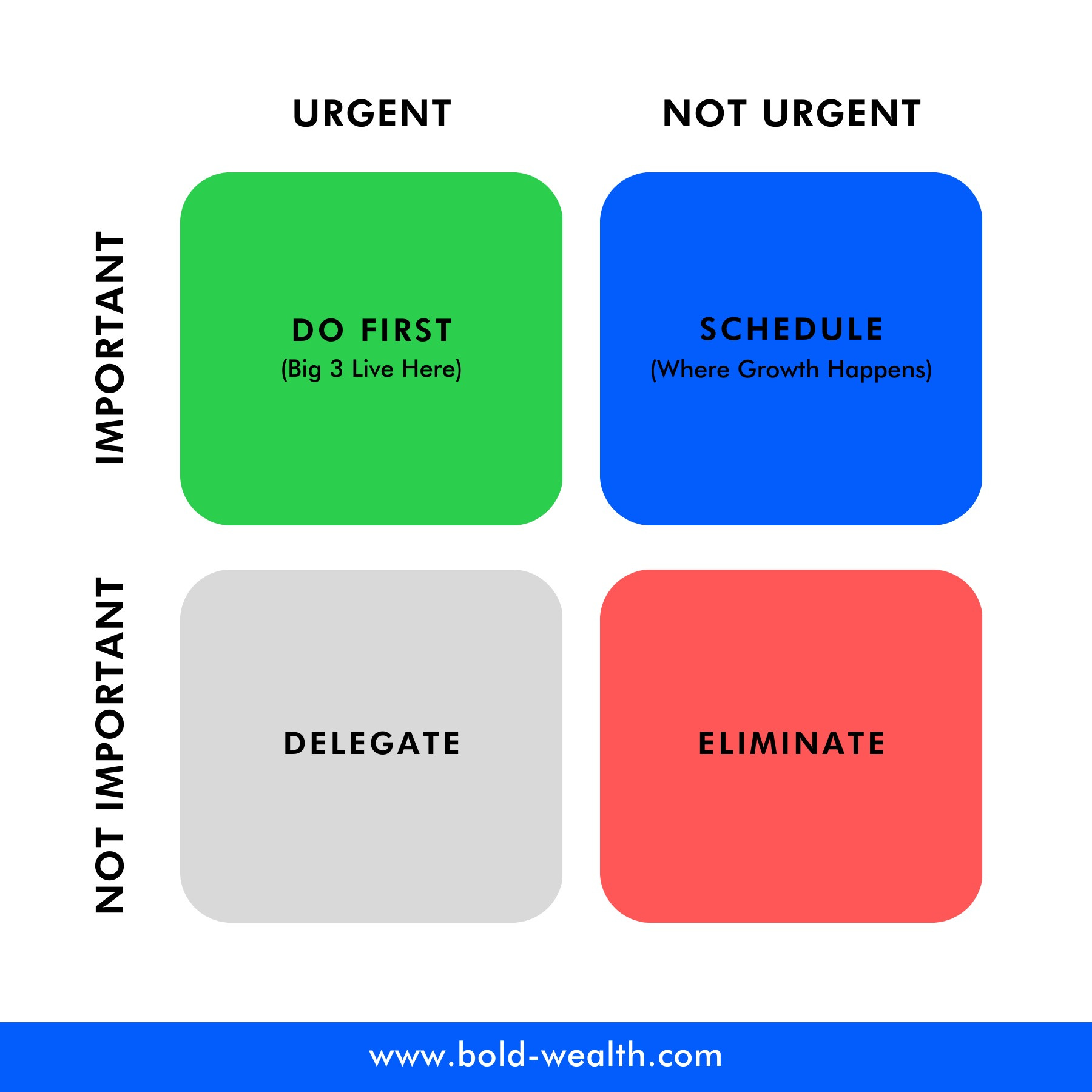
Most of what competes for our attention each day feels urgent. Emails. Requests. Problems that want an answer now. Urgency is loud. It creates pressure. It tricks us into thinking everything matters equally.
But urgency is a terrible filter for importance.
Many of the things we react to all day don’t actually move our lives forward. They just demand attention. When you live this way, you stay busy but rarely make progress.
The Big 3 is my guardrail against that.
It forces me to decide what’s truly important before urgency takes over. Because if I don’t choose what deserves my best energy, my day gets consumed by whatever is loudest.
That’s how people end up stuck in reactive mode. Working hard all day. Answering emails. Putting out fires. And going to bed feeling exhausted but unfulfilled.
Time-blocking what matters is how I make sure importance gets a seat at the table, not just urgency.
This idea is often called the Eisenhower Matrix. Urgent tasks shout. Important ones quietly shape your life.
Planning Your Money the Same Way
This is where time habits and money habits quietly intersect.
Most people don’t struggle with money because they’re bad at math. They struggle because money lives in reactive mode. Bills get paid when they’re due. Investments get checked when markets move. Savings happens if there’s anything left over. Money becomes something you respond to instead of something you intentionally direct.
That’s not a character flaw. It’s a default setting.
For years, that’s exactly how my money operated, just like my mornings used to. And when money isn’t planned, it still takes up mental space. It just shows up at the worst times. Late at night. During stressful conversations. In moments when decisions feel rushed instead of thoughtful.
That’s when money becomes heavy.
Over time, I realized the solution wasn’t more discipline or obsessing over numbers. It was giving money a place, the same way I learned to give my time a place. I stopped letting it float around in the background and started planning for it intentionally.
For me, that looks like a simple weekly money block. A set time on the calendar to review accounts, check cash flow, think through upcoming expenses, and make sure our spending still reflects our priorities. Nothing fancy. Nothing overwhelming. Just consistent and intentional.
When money has a place on your calendar, it stops hijacking your mind at random moments. Decisions get clearer. Stress softens. You’re no longer reacting. You’re directing.
And this only works if you know what you’re aiming your money toward in the first place, which is why getting clear on your values matters more than any spreadsheet ever will. If you haven’t yet, this connects directly to Know Your Values, and you can read it here.
Time-blocking your money isn’t about obsessing over it. It’s about using it as the tool it was always meant to be.
Why I Structure My Day This Way
My goal isn’t to cram more work into fewer hours. My goal is to be finished by the time my kids get home from school.
That’s why I structure my days the way I do. Not because I don’t care about work, but because I care deeply about what happens after it.
When they walk in the door, I’m there. Homework at the table. Questions about their day. The inevitable math help request.
We eat dinner together as a family every night. We talk. We play. Sometimes we just sit in the same room, each doing our own thing.
And when I’m with my family, I disconnect.
I don’t check email. I don’t keep it on my phone. Not because I’m unreachable, but because I’m intentional.
One bad message can ruin an evening the same way it can ruin a morning.
My family deserves my full attention. That doesn’t happen by accident. It happens by planning.
Practical Ways to Start
Planning your day doesn’t require a full overhaul. Small changes compound.
Choose your Big 3 each morning. If nothing else gets done, those three things will. My Big 3 most weekdays are three work related items that I know I want to get done, no matter what.
Time-block what matters most before you open your inbox.
Batch emails and admin into a single window instead of letting them leak into everything else. Do the same with money. One weekly check-in is better than constant low-grade stress.
Build your schedule around your values. For me, that’s family dinners and evenings together. For you, it may look different. But your calendar should reflect what you say matters.
The Bigger Picture
Planning habits aren’t about rigidity. They’re about alignment.
Wealth isn’t just money. It’s time. And when you design your days intentionally, you reclaim both.
Money is a tool. Planning is a tool too. Used together, they allow you to live by your values instead of someone else’s schedule.
That’s the real payoff.
Your Turn + Start Bold
This week, don’t try to overhaul your entire life. Choose one small planning habit that brings more clarity.
Maybe it’s protecting the first hour of your morning. Maybe it’s writing down your Big 3 before opening email. Maybe it’s scheduling a weekly money check-in instead of letting finances linger in the background.
Try one thing. Notice how it feels. Planning creates space. Space creates better decisions.
Progress equals happiness.
What’s one habit you’re planning on purpose this week?
Looking Ahead
Next week, we’ll talk about growth and learning.
Because once your energy is protected and your days are planned with intention, the question becomes: what are you doing with that capacity?
Planning creates space. Growth determines how that space gets used.
Why We Build Wealth
We plan our days and grow our wealth so our time reflects our values, not just our obligations. That’s BOLD Wealth.
New to BOLD Wealth?
Here’s a simple Blueprint to BOLD Wealth that explains the philosophy, the core frameworks, and how money fits into a life that actually feels rich.
A Favor - will you consider clicking the 💚 on this email?
Clicking the little heart icon at the bottom or leaving a comment helps these posts to reach more people (and also makes my day!). If you liked what you read, consider clicking the heart or leaving a comment. Thank you so much in advance!
I love everything about this post. A friend of mine, Simon T Bailey, used to say “How you start your day determines the day.“ There are several new things I’m trying in my mornings and this post encouraged me to do even more. Thank you!
This one resonates with me. About 10 years ago I started exercising without my phone. Didn't carry it if I ran and put it in a cubby in the lobby of the gym (still do). It's my one hour to focus on me and my health...to be intentional. It changed the way I exercised, the way I felt, the way I think...there was no temptation to check it b/c it wasn't there. That being said, I'm glad I get to help sharpen your focus every day at 6am with all of my distracting comments. ha!. :) (You're welcome.) In all seriousness though, never thought about blocking time for financial thoughts each week...consider it done.