
Why Successful Men Are Waking Up Relationally Broke
Our culture teaches men to build identity around work and family, but says almost nothing about maintaining friendship along the way.

Hi, I’m Chris. I’ve spent the last 25 years building businesses, wealth in real estate, and learning what actually matters along the way. Most people don’t fail; they drift. Here, I share how to create wealth and live a life that doesn’t decline.
Jason and I have been friends since we were four years old.
We went to preschool together in Pittsburgh. We were at each other’s birthday parties, played on the same teams, and grew up in each other’s houses. He is my best friend in the most literal sense, the person I have known longer than almost anyone alive. And now, more than forty years later, he is also my business partner. His office shares a wall with mine. We have built things together with Legos and now with real homes on real land.
Jason and I did not stay close by accident. Our friendship survived because we both kept showing up through different seasons, stages of life, pressures, and now decades of business together. We stayed intentional about the relationship.
And to be clear, the point is not that you need a best friend from preschool. The point is that meaningful friendships do not maintain themselves.

Having hit a significant birthday recently, I’ve been thinking about friendship and relationships more than usual. That intention, whether you are four years or forty years into a friendship, is what this post is about.
Most Men Do Not Notice Their World Getting Smaller
Most men do not intentionally choose isolation. It happens slowly.
They pour themselves into work, into marriage, into raising kids, into providing, building, achieving, and carrying responsibility. Years go by, and without realizing it, almost their entire relational world becomes concentrated into a few roles: husband, father, provider, leader.
From the outside, life looks full. Successful, even. But underneath it, something is quietly happening: their world is getting smaller.
The American Survey Center found that the percentage of men with at least six close friends dropped from 55% in 1990 to 27% in 2021, while the percentage of men with no close friends increased fivefold.
Part of what makes this so easy to miss is that work creates the illusion of friendship. You spend more waking hours with your colleagues than almost anyone else in your life. You laugh together, solve problems together, and go through hard seasons together. It feels like connection, and in many ways it is. But be honest with yourself: are those work friends, or are they actual friends? Do you see them outside the office? Do you know their spouses, their kids, their struggles beyond the job? For most men, the answer is no, which means the moment one of you moves on, the relationship quietly disappears. It was built on proximity, not intention. And proximity is not something you can bank on.
These roles of father, provider, and leader are deeply meaningful roles. They should be. But family and friendship serve different purposes in a healthy life, and even the best family relationships cannot do everything. A spouse cannot carry the full weight of your emotional, intellectual, social, and spiritual life alone. Children are not meant to remain emotionally responsible for their parents forever. Parents age and eventually pass. Work relationships shift with careers and seasons. When all of your connections and identity are concentrated into only one or two relational categories, life becomes very fragile when those categories inevitably change.
You Are Probably Measuring Life Wrong
There is a study from Harvard that followed the same group of people for over 80 years. The researchers expected the data to point toward money, status, or physical health as the drivers of a long and happy life.
It did not.

The single greatest predictor of health and happiness in later life was the quality of close relationships. Not wealth. Not career success. Relationships.
Most men evaluate life almost entirely through the lenses our culture rewards: career growth, financial success, productivity, achievement, and status. But if you optimize only for those things, you can wake up one day successful on paper and relationally bankrupt underneath it all. The Harvard data does not suggest that money and career don’t matter. It points out that if those are the only things you build, you leave the most important variable completely unaddressed.
Stop Evaluating Your Life by Career and Money Alone
That is why I think about life as a wheel with ten spokes.
Each spoke represents something that truly matters: your intimate relationships, family, social circle, health, fun and adventure, career, finances, personal development, spirituality, and contribution to others. When the spokes are in balance, the wheel rolls smoothly. When one is neglected for too long, the whole ride gets bumpy. If you want to go deeper into the framework, the full Wheel of Life post is here.
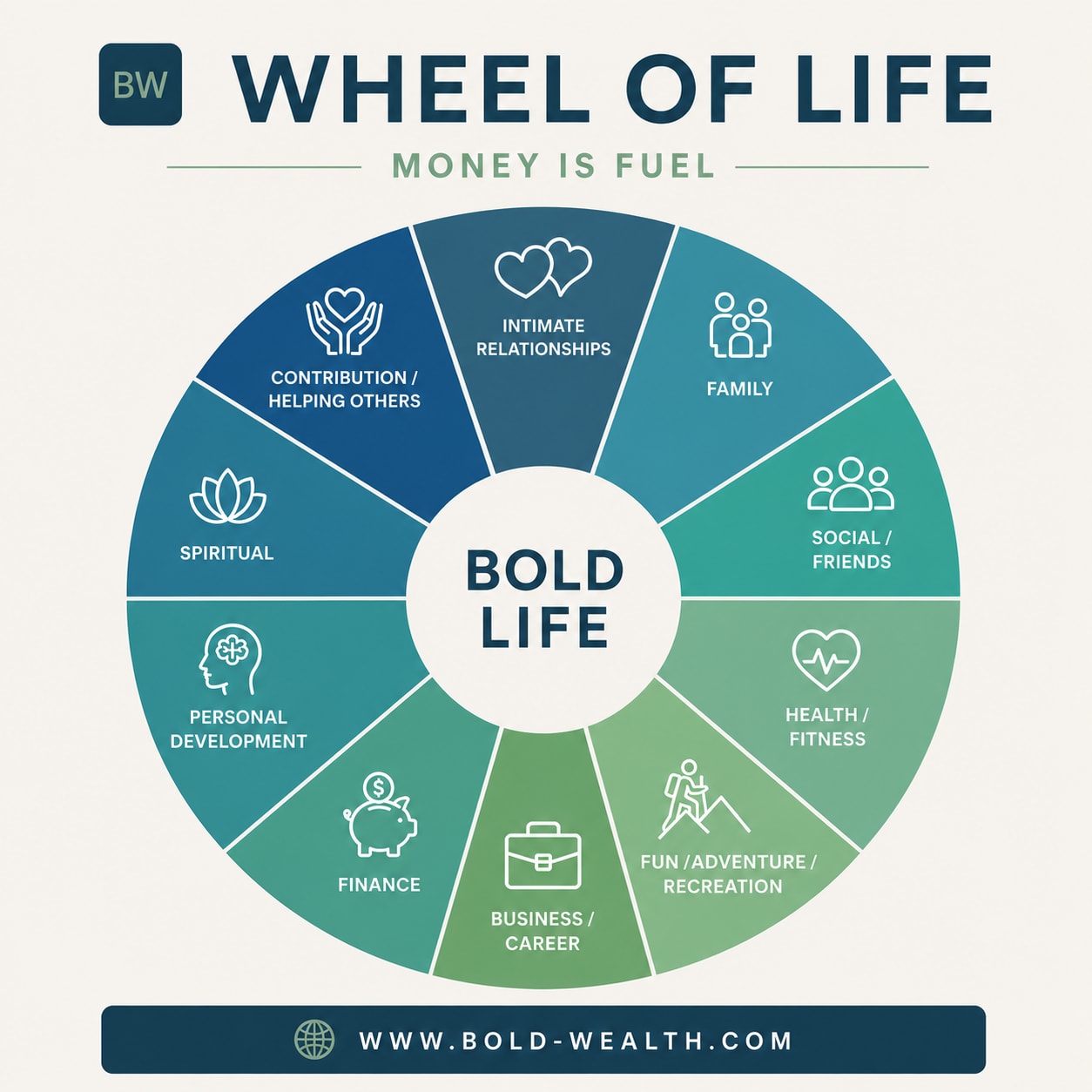
Three of those ten spokes are relationships. Money is fuel. But your people are the destination.
Think about who is actually in your daily orbit right now. Who shapes your thinking? Who do you debrief with at the end of a hard day? Who would show up if things fell apart? Jim Rohn famously said that you are the average of the five people you spend the most time with. The people closest to you are quietly shaping your life every single day. Their mindset affects yours. Their standards affect yours. Their priorities eventually become part of your own.
Your Marriage Is Either Deepening or Drifting
If you’re married, your spouse is almost certainly the most influential person in that circle of five. And if you are being honest with yourself, you probably know whether you are truly tending to that relationship or just managing it.
There is a difference.
Managing a marriage means coordinating schedules, dividing responsibilities, and keeping the household running smoothly. Tending to it means you are still choosing each other, still curious about each other, still showing up as friends.
Jana is my anchor. She challenges me, pushes back when I need it, and supports me when that is what I need instead. But that did not happen by accident, and it does not stay that way without effort. If you have a great marriage, do not assume it will stay great on autopilot. And if there is distance growing quietly between you and your spouse, do not wait for a crisis to close it. That relationship is the foundation on which everything else is built.
And a note to the wives and women reading this: thank you for being here. If there is a man in your life who needs to hear this, send it his way. And know that the same principles apply to you. Strong friendships make all of us better: better partners, better parents, more grounded people. Encourage the guys’ trip. Support the phone call. Surround yourself with people who are growing and help the people around you do the same. We all feed off each other more than we realize.
One Day, the Roles Defining Your Life Will Change
When my boys were young, they were my world in the most immediate, present-tense way. They still are. But Max and Mason are thirteen now, and I can already see the shape of things to come. They are finding their own friends, developing their own interests, building their own lives inside of ours. That is exactly what is supposed to happen. I want them to want to be part of my adult life someday, and I hope I am doing the work now to earn that. But even if everything goes right, even if I win at this parenting thing, they will still have their own lives.

Men, in particular, tend to build their identity around two things: their work and their family. Work is who we are. Family is who we do it for. That combination is powerful and meaningful, especially when we are in the thick of our careers, in a good marriage, with young kids at home filling up the house with noise and chaos and need. I love that season. I am in it.
But it is not always going to be that way.
Nobody Warns Men What Happens Next
What happens when you lose a job, sell your company, or retire? When the title disappears, the calendar empties, and the thing you spent decades introducing yourself as suddenly becomes past tense?
And then there is the other transition, the one nobody likes to think about.
I work with my mom. She lives down the street from me. She is healthy and active, and one of the best real estate agents in the Triangle, and my boys believe that will simply continue forever because that is the only version of her they have ever known. I hope they are right for a long time. But I lost my dad three years ago, last Friday. He had been disabled for most of my adult life, and I had taken care of him, and then he was gone. The absence of a parent is its own kind of rearranging. Your whole family structure shifts.
Careers end. Kids grow up. Parents pass away.

And a lot of successful men eventually discover they built lives that looked incredibly full from the outside while becoming dangerously narrow underneath. That is the part our culture rarely talks about. We celebrate men for building companies, providing for families, and carrying responsibility. But almost nobody warns them how easy it is to slowly lose friendship, community, and relational depth along the way.
Until one day, they wake up relationally broke.
The Good News Is That You Can Change This
This is usually not about finding one perfect forty-year friendship. Most men will never have that, and that is not the point. The point is whether you are intentionally building and maintaining relationships that continue beyond convenience, proximity, work, or a particular season of life.
That starts smaller than most men think. Text the friend you keep thinking about but never reach out to. Invite another guy to dinner instead of assuming everyone is too busy. Join the gym class. Go on the guys’ trip. Say yes when someone invites you somewhere.
Friendship rarely disappears all at once. It fades slowly through neglect. But strong friendships are built the exact same way: through small, consistent acts of showing up.
The strongest lives are not just financially secure; they’re relationally deep. And the friendships you will lean on later are usually built long before you need them.
Next week I am going to get practical. How do you actually build and maintain meaningful friendships as an adult when everyone is busy, distracted, exhausted, and spread thin? That is what we are talking about next.
Start Bold
Do you think modern life makes it harder for men to maintain deep friendships? I would love to hear your honest answer in the comments. One sentence is enough.
We build financial wealth not for status or scorekeeping, but to fuel the areas of life that matter most: family, health, growth, generosity, joy. Relationships are the spoke that makes all the others worth spinning.
Minor in money. Major in life.
If you found value here, please consider clicking the 💚 below. It helps these ideas reach more people, and I am grateful you are here.
There is a lot of truth to all of this. There feels like there is a certain nobility to being tirelessly dedicated to work and then giving whatever is left to the wife and kids. It’s unselfish and solidifies the man as the provider and “family man”. I don’t think this is completely wrong, but it can leave a man with shallow or non-existent friend relationships. There needs to be a balance.