
The Matrix of Wealth & Life Enjoyment
True wealth is not what you earn, it is how you live.

“Wealth is not his that has it, but his that enjoys it.” – Benjamin Franklin
Years ago, I remember sitting in my home office late at night after putting my baby boys to sleep. The house was quiet. I should have been resting, but instead I was back at the computer, trying to catch up on the day I never seemed able to finish. The businesses were growing. My net worth was higher than it had ever been. On paper, I was “winning.”
But I was exhausted. I was always one email, one text, one loose end away from being pulled out of the moments that actually mattered. I wanted to be present with my family, but my mind was still solving problems no one expected me to fix at 10 p.m.
That night, I finally stopped and wrote something down that I couldn’t ignore:
“If this is success, why does it not feel the way I thought it would?”
That question eventually led me to a simple but powerful idea I now call The Matrix of Wealth & Life Enjoyment.
Most people spend their whole lives chasing wealth without ever pausing to ask what purpose it is meant to serve. Money, by itself, has no meaning. Its value comes from what it allows you to experience. The freedom to spend time where it matters. The ability to share moments with the people you love. The opportunity to live in alignment with your values.
Over the years, I have met people on both ends of the spectrum. Some have an enormous net worth but very little time or energy to enjoy life. Others appear to live richly, but only because they spend faster than they earn. Both are missing the point.
This simple framework will help you see not just how much money you are building, but how much life you are actually living. Because true wealth is not about accumulation; it is about alignment.
The Matrix Explained
The Matrix of Wealth & Life Enjoyment is built on two questions:
How much money are you building?
How much enjoyment are you actually experiencing?
Picture it as a graph.
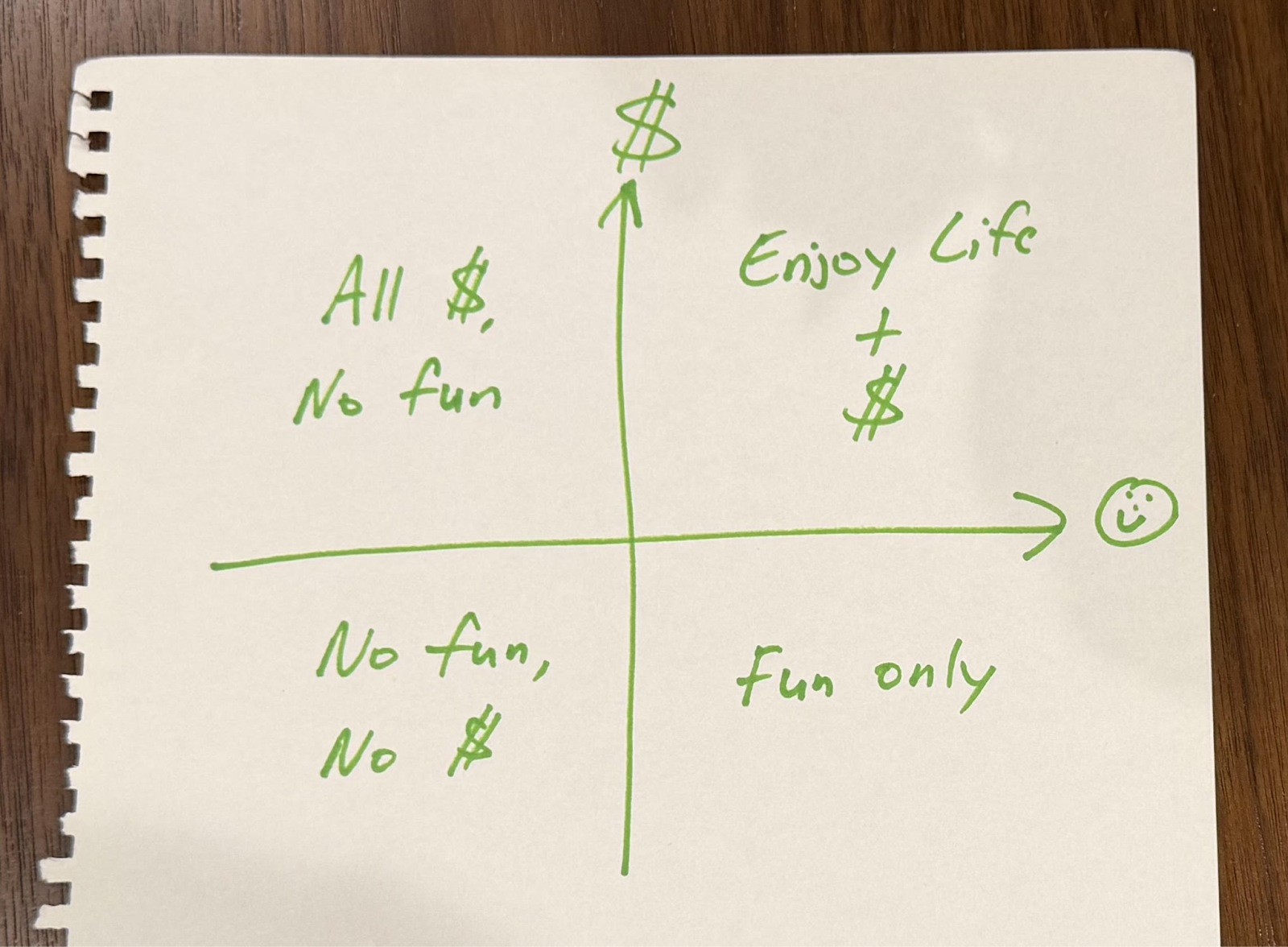
The vertical axis is Net Worth. Your financial stability and progress.
The horizontal axis is Life Enjoyment. Your fulfillment, peace, and joy.
When you plot those two together, you get four quadrants. Each one reflects a different relationship between money and meaning. Understanding where you are today is the first step to changing it.
Lower Left: The Hamster Wheel
Low net worth, low enjoyment.
This is survival mode. You work long hours, juggle responsibilities, and no matter how hard you push, the finish line never gets closer. Every paycheck is gone the moment it arrives.
Money isn’t freedom here; it’s stress. Every dollar is spoken for, and every unexpected expense feels like a crisis. I’ve known people in this place, and it’s heartbreaking. They aren’t lazy; many work harder than anyone else. They just lack leverage, opportunity, or financial tools. They’re trading time for money and running to stay in place.
Escaping the hamster wheel starts with awareness. You can’t change what you can’t see. Learning how money works, tracking spending, building a small buffer, and increasing earning power are the first steps. You don’t move out of this quadrant with one big decision, but with small, wise choices that compound over time.
Lower Right: The Spendaholic
Low net worth, high enjoyment.
From the outside, this quadrant looks fun. Trips, cars, nights out. Life appears exciting, even enviable. But behind the highlight reel, the foundation is fragile.
When I was a mortgage broker, I saw this often. People looked successful, but their numbers told a different story. Some couldn’t pull together a down payment. Others refinanced repeatedly to pay off credit cards and maintain the lifestyle. They had the appearance of wealth, but not the stability. Living rich while feeling poor.
It works for a while, but it’s built on stress. One setback, like a job loss, an illness, a surprise bill, can upend everything. When your money isn’t working for you, you have to keep working for it. This isn’t about guilt. It’s about awareness. Enjoyment is good, but enjoyment without stability is fragile. Real freedom comes when your joy is sustainable.
Upper Left: Financial Wealth, No Enjoyment
High net worth, low enjoyment.
Many high achievers end up here. The accounts look strong, but the life doesn’t feel that way. It’s the executive working eighty-hour weeks, the entrepreneur who can’t step away, the saver who built wealth but forgot what it was for.
I’ve lived in this quadrant. In my thirties, I was building businesses and chasing milestones, telling myself it was all for freedom, while being too busy to feel free. I had money, but not peace. Results, but not rest.
A good friend once said to me, “With Chris, everything is a transaction.” At first, I brushed it off. But later that night, it stayed with me. I kept hearing the sentence replay in my head. And the longer I sat with it, the more I realized he was right. I was evaluating everything by its financial return. It made me productive, but it also made me restless.
You can win on paper and still feel like you’re losing in life. Many people here already have what they once dreamed of, but because their identity is tied to achievement, they don’t know how to slow down. They keep climbing without asking, “What is the mountain for?” Leaving this quadrant doesn’t mean losing ambition. It means redefining success: using money to buy back your time, your health, and your joy.
Upper Right: The Sweet Spot – BOLD Wealth
High net worth, high enjoyment.
This is where financial strength and meaningful living come together.
It’s not about status or stacking zeros. It’s about using money as a tool to buy back your time, deepen relationships, and build a life that actually feels like a life. Here, you work because you want to, not because you have to. You spend time on what matters: family dinners, health, experiences, and growth. You invest in your values instead of your image.
Over the years, I’ve moved intentionally toward this quadrant. I still love business and building things, but I see money differently now. It isn’t the finish line. It’s the fuel. I could stop working tomorrow, but I won’t. I’ll probably work the rest of my life - not out of necessity, but because I enjoy the challenge and the impact. The difference now is that my work supports my life, not the other way around.
That is BOLD Wealth. Not having everything, but enjoying what you have while continuing to grow toward what matters most.
Good Enough vs. Growth Mindset
The biggest danger in all of this is not failure. It is settling for “good enough.”
Good enough keeps you in the hamster wheel, hoping that someday it will get easier. Good enough keeps you spending to keep up, telling yourself the stress is worth it. Good enough keeps you stockpiling wealth, promising yourself you will enjoy it “later.”
But later does not always come.
A growth mindset says something different. It says, “I can do better.” I can build wealth and still live fully. I can keep growing without losing balance. I can move closer to that upper right quadrant where money and meaning work together. That shift starts with awareness. Once you see where you are, you can start taking small steps toward where you want to be.
Progress does not require perfection. It just requires movement in the right direction. And progress equals happiness.
My Moves
Over the years, I have lived in almost every quadrant of this matrix. When I first started working, I was firmly in the lower left. Long hours, little leverage, every dollar earned with sweat.
As I learned, saved, and invested, I moved into the upper left. I had real net worth, but I was still letting money call all the shots. My mindset was simple: sacrifice now so I could have more later. It worked financially, but it cost me presence.
In more recent years, I have been intentional about shifting into the upper right. I still work hard, but the reason is different. I want my life to be rich in money and rich in meaning. I protect family time. I say “no” more often. I think of time as my most precious asset, and money as a tool to protect it. Every day, I am trying to move a little higher and a little more to the right. Toward greater wealth. More joy. A more balanced life.
Where Are You on the Matrix?
Take a moment to locate yourself honestly.
Are you in the hamster wheel, always working but never gaining ground?
Are you living it up now but anxious about the future?
Are you stacking money but missing joy?
Or are you starting to move toward that sweet spot where money fuels meaning?
This is not about judgment. It is about awareness. Awareness is the spark that creates change. Once you see where you are, you can start taking small, intentional steps toward where you want to be.
💡 Your Turn + Start Bold
Where are you on the Matrix of Wealth & Life Enjoyment today?
Start Bold (Simple First Steps):
Draw your own matrix and mark where you honestly are right now.
Pick one step to move closer to the top right. Save a little more or plan a meaningful experience with someone you love.
Ask yourself: Does my money reflect my values, or am I defaulting into someone else’s plan?
Try one step this week. Notice how it shifts your perspective. Then come back and tell me your story. I would love to hear where you are on the matrix.
Why We Build Wealth
At BOLD Wealth, we believe wealth is not just what you accumulate, but how you use it. Money without enjoyment is wasted. Enjoyment without money is fragile. We build financial wealth not for scorekeeping or status, but to unlock freedom, freedom to live aligned with our values, connected to the people we love, and fulfilled by the work and choices that matter most. That is the real payoff. That is what it means to minor in money and major in life.
A Favor - will you consider clicking the 💚 on this email?
Clicking the little heart icon at the bottom or leaving a comment helps these posts to reach more people (and also makes my day!). If you liked what you read, consider clicking the heart or leaving a comment. Thank you for your support!
This made me think of Solomon's book of Ecclesiastes 5:19 "Also, every man to whom God has given riches and possessions, He has also given the power and ability to enjoy them and to receive his portion and to rejoice in his labor-this is the gift of God to him."
Thanks for sharing Chris! I was exposed to the matrix you shared many years ago, but had forgot it. This was a good reminder. It was around 1989 that I decided money gave me more freedom, security, and enjoyment. However, the accumulation of stuff many times felt like more of a burden than an enjoyment. I now purposely try to only spend money on things that give me or my friends and family freedom, security and/or enjoyment without undue burden.